
Introduction: Why “40 Chairs” Is Not a Furniture Plan
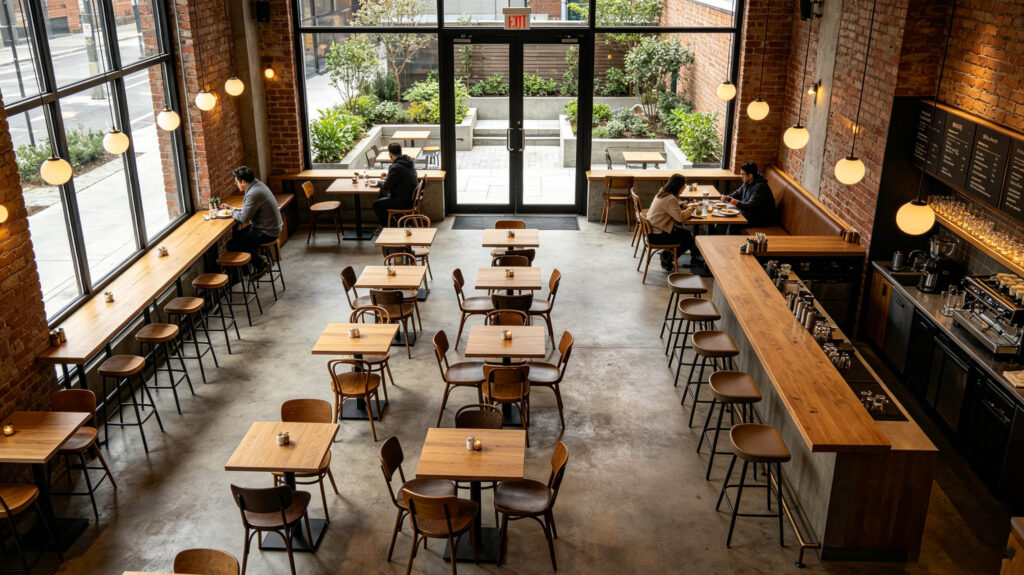
You ran the numbers. Forty seats. Average check $35. Three turns per lunch shift, pushing $125,000 a month. The math works on paper. But what you didn’t factor in was the furniture—specifically, the cost of buying it wrong.
Two oversized armchairs steal 10 inches from your aisle, and suddenly your turn time stretches from 45 to 62 minutes. A missing high-top by the window removes your most Instagrammable spot, and organic foot traffic quietly drops 15%. The real trap is the “buy cheap now, upgrade later” logic. It sounds safe until you calculate the revenue you lose during the three days of closure needed to swap out chairs.
This guide gives you a tested, space-efficient furniture configuration for a 40-seat cafe. You’ll get zone-by-zone seat-type ratios, realistic budget tiers.
At Dejell, we manufacture commercial cafe furniture and work directly with owners to avoid these expensive layout mistakes. The recommendations below come from real projects—not theory.
1. 40-Seat Cafe Layout: Seat-to-Capacity Ratio Is What Actually Pays
Your business plan counts seats. Your revenue counts effective capacity—how many guests you can serve per hour without friction. Friction happens when aisles pinch, servers can’t pass with a loaded tray, or guests feel cramped and leave before ordering dessert.
In a full-service cafe, maintain a 32–36 inch service aisle. Below 30 inches, tray clearance becomes a gamble. Below 28 inches, guest reviews start using the word “packed,” even when you have empty seats.
Seat type directly changes effective capacity. A two-top turns faster than a four-top. A bar seat turns twice as fast as a lounge chair. The furniture you pick dictates your flow just as much as your menu does.
💡 From Dejell:We provide complimentary floor-plan sketches for projects with 30+ seats. Our team checks sightlines, aisle widths, and server paths before recommending any configuration. One Shanghai specialty cafe switched four window two-tops to high-tops with our armless stackable chairs—and saw a 22% improvement in peak-hour turn rate.
2. The Four-Zone Seat Mix for 40 Seats
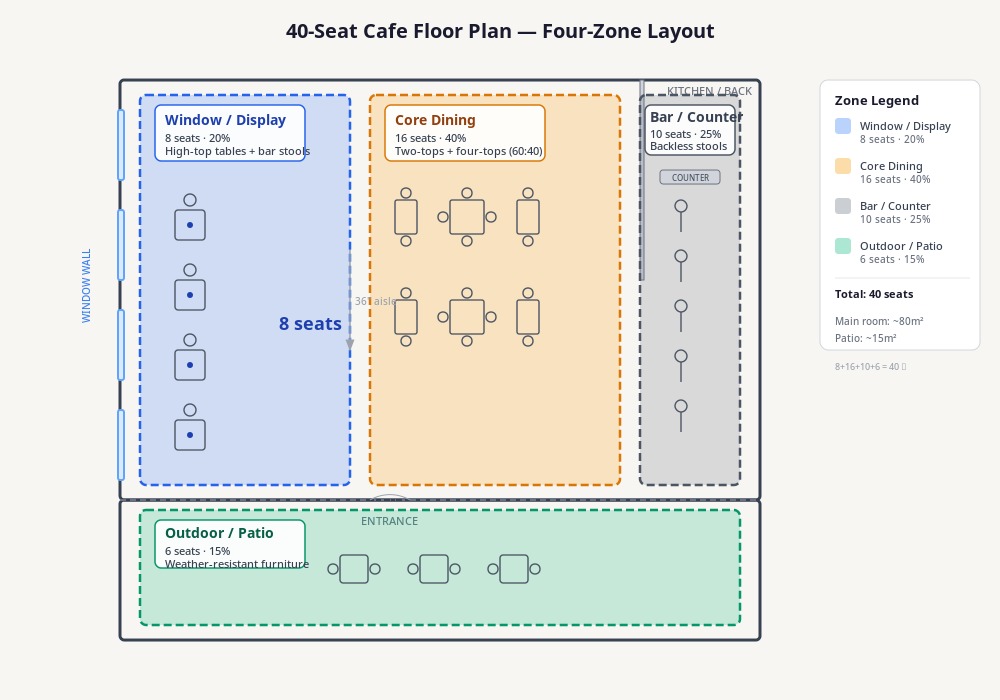
A single chair type kills both atmosphere and efficiency. Different zones serve different customer behaviors, and the mix determines your revenue ceiling.
Recommended configuration for 40 seats:
| Zone | Seats | % | Furniture | Revenue Role |
|---|---|---|---|---|
| Window/Display | 8 | 20% | High-top tables, bar stools | Instagram draw, solo workers, quick turns |
| Core Dining | 16 | 40% | Two-tops + four-tops (60:40) | Main revenue, 45–60 min stays |
| Bar/Counter | 10 | 25% | Bar stools, backless or low-back | Fastest turns, overflow, walk-ins |
| Outdoor/Patio | 6 | 15% | Weather-resistant chairs, small tables | Seasonal premium, pet-friendly, smoking |
Window Zone earns its keep before anyone sits down. A high-top with natural light becomes free marketing. Solo guests and remote workers favor this area, generating steady off-peak revenue.
Core Dining is your workhorse. Mix two-tops and four-tops 60:40. Two-tops fill more completely with odd-numbered parties and turn faster. Four-tops can be pushed together for a six-top when needed.
Bar/Counter seating turns in 25–35 minutes. It absorbs peak-hour overflow and captures walk-ins who won’t wait for a table. Backless stools encourage speed; low-back upholstered stools stretch stays slightly, raising check averages.
Outdoor Zone: Even a small patio brings a 10–15% revenue premium in good climates. But the furniture must be genuinely weather-resistant, not just “outdoor-style.” More on materials in Section 4.
💡 From Dejell:We stock zone-ready cafe furniture sets—high-tops, two-tops, stackable chairs—and can ship a complete 40-seat configuration within 14 days on core SKUs. [View our cafe collection →]
3. Cafe Furniture Cost: Three Budget Tiers for 40 Seats
The spread between economy and flagship is wide. The difference isn’t just aesthetics—it’s durability, warranty length, and what you’ll actually pay over five years.
| Tier | Total Budget | Frames | Tabletops | Upholstery | Use Case |
|---|---|---|---|---|---|
| Economy | $8,000–12,000 | Powder-coated metal, plywood core | Laminate, sealed veneer | Basic vinyl or bare wood | High turnover, fast casual, 3–5 year horizon |
| Mid-Range | $15,000–22,000 | Solid wood or metal-wood hybrid | Wood veneer, compact laminate | Commercial fabric or leatherette (50K+ rubs) | Full-service cafe, 5–7 years, brand-conscious |
| Flagship | $28,000–40,000 | Solid hardwood, custom metalwork | Solid surface, stone, or custom veneer | Premium fabric, full-grain leather | Destination cafe, design-led brand, 7–10 years |
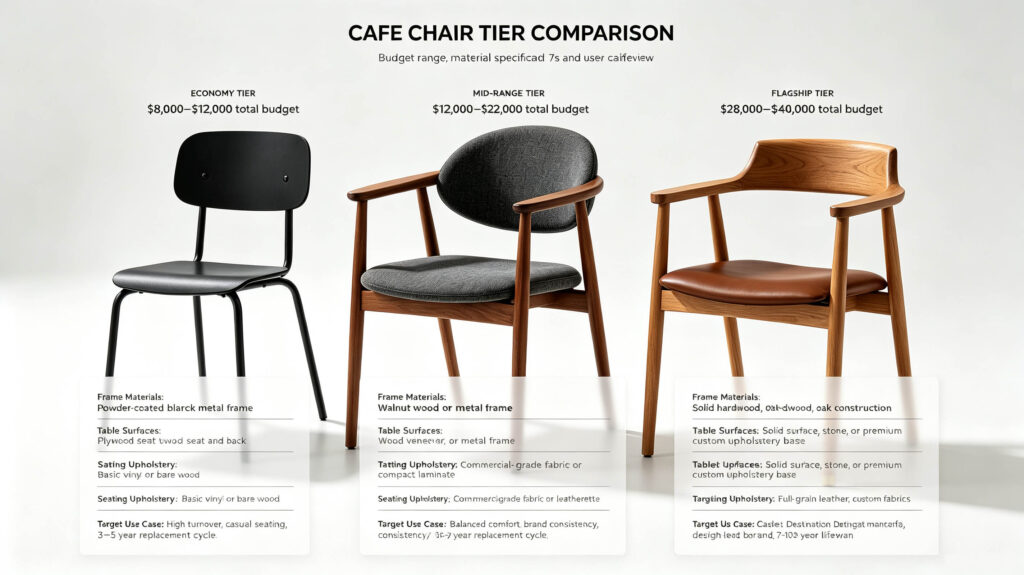
Economy runs roughly $200–300 per seat. The risk point is seating surfaces: basic vinyl often cracks within 18–24 months under heavy turnover. If you’re testing a location for two years before reinvesting, this tier works. If you’re building a brand, factor in replacement cost now.
Mid-Range ($375–550/seat) is the sweet spot for most independent cafes on a five-year lease. You get solid wood or hybrid frames, fabrics rated 50,000+ Martindale rubs, and tabletops that withstand daily sanitizing without edge swelling.
Flagship ($700–1,000/seat) buys customization, extended warranties, and design coherence that becomes part of your brand identity. Amortized over eight years with minimal replacement, annual cost can rival mid-range.
💡 From Dejell:Our “Cafe Launch Package” covers economy through mid-range, with a minimum order of 30 pieces. We stock core cafe SKUs for 14-day delivery and offer custom finishes on orders over 50 pieces. [Request a quote for your tier →]
4. Five Cafe Layout Mistakes That Erase Seats
Even good furniture placed badly destroys your investment.
1. Armchairs That Steal Your Aisle
An armchair with a 24-inch total width needs a 26-inch envelope to be pulled out. In a 36-inch aisle, that leaves 10 inches of clearance—not enough for a server with a tray. Spec armless chairs or chairs with integrated arms under 22 inches wide for narrow layouts.
2. Wrong Table Diameter for Two-Tops
A 60 cm (24”) table holds coffee and a pastry. For a full breakfast with plates, drinks, and a laptop, 70 cm (28”) is the functional minimum. Too small, and guests stack vertically and leave sooner, lowering check averages.
3. Bar Height Mismatch
A 75 cm (30”) counter with 65 cm (26”) stools leaves a 10 cm gap. The ergonomic standard is 25–30 cm between seat and underside of counter. Measure your counter before ordering stools—not after.
4. Ignoring the “Golden Corner”
Every cafe has one corner with natural light, entrance visibility, and wall space. That corner should anchor your most photogenic seating. Fill it with a storage cabinet, and you’ve converted a marketing asset into a cost center.
5. Outdoor-Indoor Style Discontinuity
Guests form their impression at the entrance. If your patio uses generic folding chairs while inside is walnut and leather, the message is: “The inside matters. Outside is an afterthought.” Coordinate finishes and color palette across all zones.
5. Order-to-Opening Timeline: What to Expect
Furniture delivery is often the last milestone before soft opening. Getting the timeline right avoids costly rush shipping.
| Model | Timeline | Best For | Trade-offs |
|---|---|---|---|
| Stock Direct | 2–4 weeks | Tight deadlines, standard designs | Limited finishes, no customization |
| Standard Custom | 6–10 weeks | Brand-specific colors, minor size tweaks | 20–30% cost premium vs stock |
| Full Custom | 12–16 weeks | Unique designs, proprietary frames | Highest cost, tooling investment |
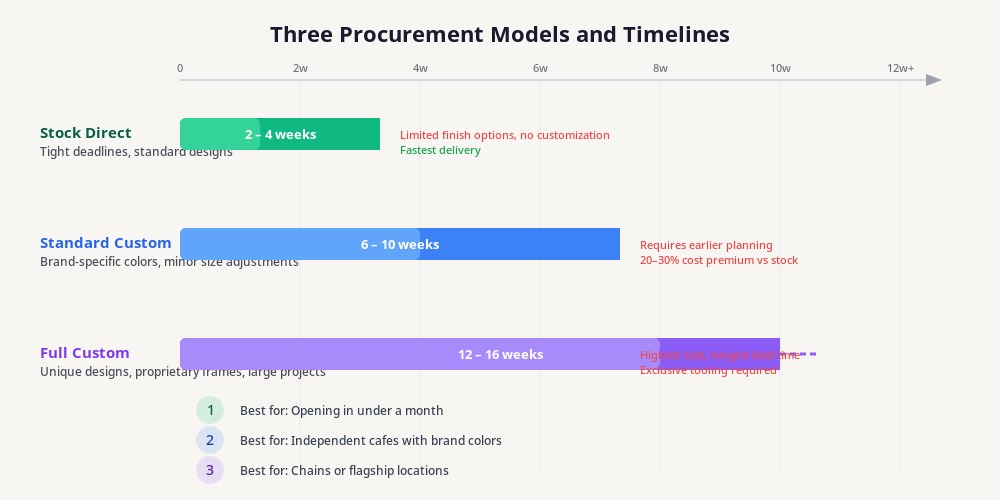
Stock Direct ships from our distribution center. The risk is adapting your color scheme to what’s available.
Standard Custom modifies existing designs with your chosen fabrics, finishes, and dimensions. This is the path most independent cafes take.
Full Custom requires engineering, prototyping, and tooling—typically for chains or flagship locations.
Conclusion: Download Your Free Cafe Furniture Calculator
A 40-seat cafe is not a huge operation, but it is precise. Every seat has a revenue target. Every inch of aisle affects turn time. Every material choice dictates your replacement schedule. The furniture package is not a line item to minimize—it’s a system to optimize.
About Dejell
Dejell manufactures commercial furniture for cafes, restaurants, hotels, and senior living communities. Our cafe furniture is designed for high-turnover daily use, with durable materials, quick-ship options, and custom configurations for independent operators. Ready to furnish your cafe? Contact our team for a free consultation and tailored quote.